How Elevation and Offset Improve Recovery
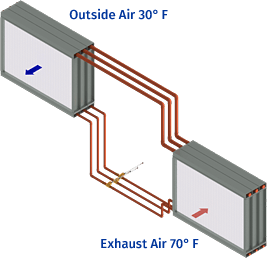
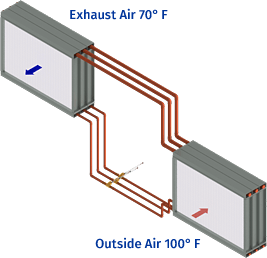
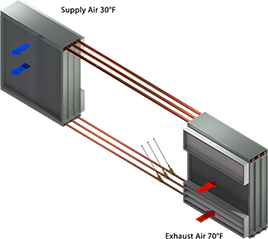
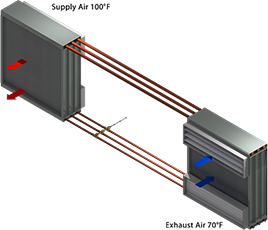
Elevation difference between the supply and exhaust air streams drives thermo-syphon circulation within the HRM-V Split Passive Heat Pipes system. As warm exhaust air passes across the heat exchanger coil, the internal working fluid absorbs heat, evaporates, and rises through the vapor header. The vapor then condenses on the supply side, releasing thermal energy before returning through the liquid header.
This continuous heat exchange cycle operates without pumps or mechanical input. The permanent elevation offset improves fluid flow and heat transfer, allowing the system to maximize heat recovery during peak conditions while maintaining strong thermal performance and overall energy efficiency.
When to Choose Split Passive Over Side-by-Side Systems
Split passive heat pipe systems are best suited for applications where supply and exhaust air streams cannot be located adjacent to each other. This often occurs in facilities with long duct runs, architectural constraints, or layouts that require separation between incoming air and outgoing air.
Applications that require complete airstream isolation, such as healthcare, laboratory, and industrial ventilation systems, benefit from this design. Maintaining separation helps protect indoor air quality and prevents cross-contamination between air streams.
Compared to traditional side-by-side heat exchangers or water run-around systems, this approach can deliver higher heat recovery in many layouts while eliminating pumps, piping, and added maintenance. This makes it a practical solution for ventilation systems and air handling unit designs where efficiency and simplicity are priorities.
Design Considerations for Peak Performance
Achieving optimal performance requires proper configuration of the heat exchanger circuits, airflow, and moisture management components. Multiple circuit options, including 2, 4, and 6 row heat exchangers, allow the system to be tailored to specific heat recovery requirements.
Moisture eliminators or extended drain pans may be required depending on operating conditions and airflow characteristics. Liquid-side control valves on each circuit provide flexibility to adjust or shut off heat recovery during economizer operation or extreme temperatures. Air flow, elevation difference, and coil configuration all influence heat transfer effectiveness and pressure drop. Careful system design ensures consistent performance while maintaining efficient ventilation and minimizing energy loss.
Maintenance and Long-Term Reliability
Long-term reliability is supported through a passive design that eliminates moving parts and reduces mechanical complexity. This minimizes the maintenance typically associated with active heat recovery systems. Routine upkeep includes periodic cleaning of the heat exchanger surfaces to remove dirt and debris and maintain proper airflow. Drainage components should also be inspected to ensure effective moisture management and prevent buildup.
For applications in corrosive or high-exposure environments, protective coatings can be applied to extend the life of the heat exchanger. These measures help maintain consistent heat recovery and reliable system operation over time.