
What is a remote condenser? Understanding the science starts with how modern HVAC and refrigeration systems manage heat. In many commercial and light industrial applications, separating heat rejection from indoor equipment improves efficiency, flexibility, and operating conditions.
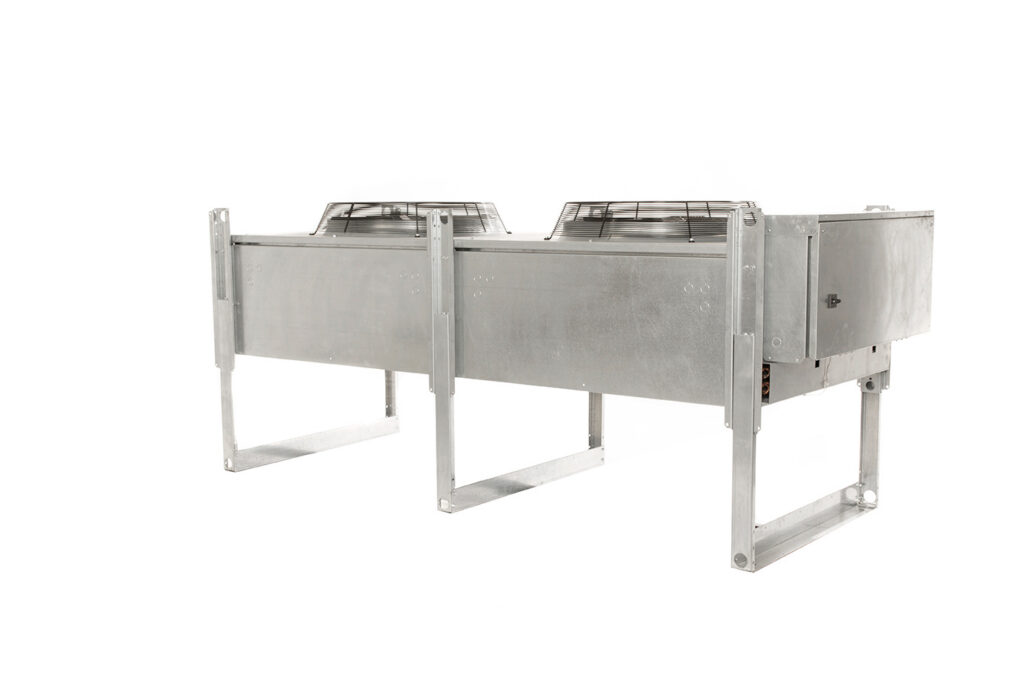
Essentially, a remote condenser is a heat rejection component installed away from the primary refrigeration or air conditioning equipment, typically outdoors. Its purpose is to release heat absorbed by refrigerant during the refrigeration cycle by moving ambient air across finned coils using powered fans.
By relocating this process, a remote condenser reduces indoor heat load and supports more flexible system layouts for HVAC technicians, facility managers, and mechanical engineers. Because this approach relies solely on air movement, it qualifies as a dry-cooling method and requires no water consumption, chemical treatment, or evaporative process.
Basic Working Principle
A remote air-cooled condenser operates during the final stage of the refrigeration cycle. After refrigerant absorbs heat inside a conditioned space, it exits the evaporator as a high-pressure vapor. This vapor enters the remote condenser, where outdoor air passes over finned coils to remove heat and condense the refrigerant into a liquid.
Fans drive airflow across the coil surface, transferring heat to the surrounding environment. Once condensed, the refrigerant returns to the compressor or expansion device to repeat the cycle. In this configuration, the remote condenser functions independently from indoor equipment, allowing system designers to manage heat rejection without adding water-based infrastructure.
Components & Construction Overview
A remote condenser unit is designed for continuous outdoor operation, and with that, exposure to changing weather conditions. While configurations vary by capacity and application, most systems share several core components:
- Finned-tube coils constructed from copper tubing with aluminum fins for effective heat transfer
- Axial or propeller fans selected for consistent airflow and energy efficiency
- Fan motors and safety guards rated for long-duty cycles
- Weather-resistant casing made from galvanized or coated steel
- Refrigerant piping connections that support extended distances between indoor equipment and the condenser
In many systems, the condenser is coupled with a remote condensing unit, where compressor selection, refrigerant type, and airflow design all work together to balance performance and operating efficiency.
Advantages Compared to Water-Cooled or Wet Systems
One of the primary advantages of a remote condenser is the elimination of water use; unlike cooling towers or evaporative condensers, air-cooled systems don’t require makeup water, blowdown management, or chemical treatment programs.
Additional advantages:
- Simplified installation with fewer auxiliary components
- Lower ongoing maintenance requirements
- Greater flexibility in equipment placement
- Reduced regulatory burden in water-restricted regions
- Improved indoor comfort due to reduced heat rejection inside occupied spaces
For facilities evaluating energy-efficient HVAC systems, a remote condenser often strikes a practical balance between performance, sustainability, and operational simplicity.
Limitations & Considerations
While a remote condenser brings clear benefits to the table, system designers still need to account for several tradeoffs. Air-cooled performance depends on ambient temperature, which means capacity can decline during extreme heat conditions; in warmer climates, larger coil surfaces or multiple fans may be required to maintain target temperatures.
A remote condenser can also require more physical space than water-cooled alternatives at the same capacity. Fan noise, airflow clearance, and refrigerant line routing must be carefully considered during the planning process. Compressor loading and refrigerant charge management are especially important when equipment is installed far from the conditioned space.
Typical Use Cases & Ideal Environments
A remote refrigeration unit is regularly used in environments where managing indoor heat and simplifying maintenance are top priorities.
The most common use cases:
- Supermarkets and commercial refrigerator systems
- Ice machines and ice makers, where removing condenser heat improves kitchen comfort
- Small to medium chiller systems in office buildings and healthcare facilities
- Light industrial refrigeration and process cooling
- Retrofit projects where installing a cooling tower is impractical
In these types of settings, the remote condenser supports stable temperature control while reducing water usage and long-term service demands.
Why Choose Coilmaster’s Remote Air-Cooled Condensers
Coilmaster designs and manufactures remote condensers for real-world HVAC and refrigeration applications. Our systems feature durable construction, optimized coil designs, and fan selections matched to actual operating conditions.
We support a wide range of refrigerant types, including options aligned with evolving environmental standards. Plus, custom configurations allow engineers and contractors to match capacity, footprint, and airflow requirements to specific project needs.
For systems that integrate fluid coolers, Coilmaster provides engineered heat rejection solutions for consistent performance across varied climates and operating loads. Learn more about our full line of remote condensers made for reliability and flexibility.
Contact Us for Specifications or Quotes
Choosing the right condenser depends on application demands, climate conditions, refrigerant choice, and system layout. Coilmaster’s engineering team can review requirements, provide technical documentation, and recommend equipment suited to your project.
Contact us today to request specifications, download product data, or discuss system design considerations.