

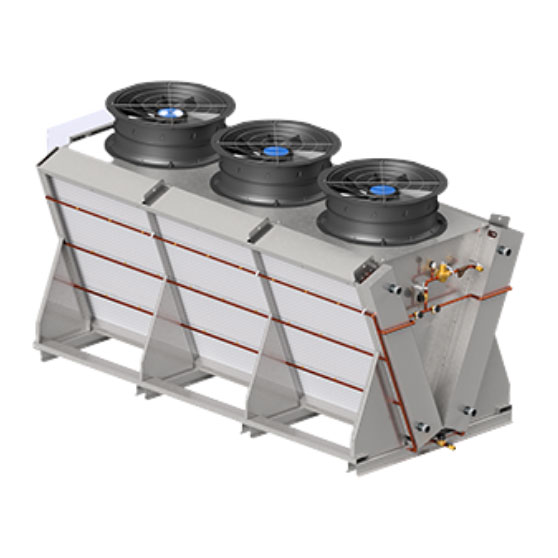
Choosing between a fluid cooler vs. cooling tower can affect heat rejection performance, water consumption, energy use, maintenance, and lifecycle costs. Engineers, facility managers, and equipment owners should consider how each technology performs under the conditions of the application.
A cooling tower uses evaporative heat rejection, while a fluid cooler keeps process fluid within a closed loop and rejects heat through a coil. Neither is universally better. Climate, thermal requirements, available water, maintenance capabilities, and operating priorities all influence the right choice.
What Is a Cooling Tower?
A cooling tower rejects heat by bringing warm water and ambient air into direct contact. Water is distributed over fill media while airflow promotes evaporation, removing heat from the remaining water.
This process allows cooling towers to approach ambient wet-bulb temperature and potentially produce leaving-water temperatures below ambient dry-bulb temperature. This can make them effective for large HVAC central plants and industrial applications.
Common configurations include crossflow and counterflow towers. Crossflow designs move air horizontally across downward-flowing water, while counterflow designs move air upward against the water. Induced-draft towers pull air through the equipment, while forced-draft towers push air from the inlet. CTI certification should also be considered when specifying and comparing tower performance.
What Is a Fluid Cooler?
A fluid cooler rejects heat while keeping water, glycol, or another process fluid contained inside a closed-loop coil. Fans move ambient air across the finned surface, transferring heat from the circulating fluid to the surrounding air.
During dry operation, heat rejection occurs without evaporative water consumption. The closed-loop design also keeps process fluid separated from outside air, limiting exposure to airborne contaminants.
Coilmaster provides dry and adiabatic fluid cooler configurations engineered around specific thermal loads, operating conditions, and site requirements.
Types of Fluid Coolers
Dry Fluid Coolers
Dry fluid coolers use ambient air for sensible heat rejection without evaporative water consumption. Performance depends on outdoor dry-bulb temperature and the required approach temperature. Since dry cooling is limited by ambient dry-bulb conditions, accurate design data is essential.
Dry operation can be especially useful where water conservation is a priority. Favorable outdoor temperatures may also create opportunities for free cooling or economizer operation.
Adiabatic Fluid Coolers
Adiabatic fluid coolers use evaporative precooling to lower entering-air temperature before it reaches the heat exchanger. This can provide additional heat rejection capacity during warmer conditions.
Water is used only when supplemental capacity is needed, allowing the equipment to operate dry during favorable conditions. This provides a balance between thermal performance and water conservation.
Fluid Cooler vs Cooling Tower: Key Differences
A cooling tower vs. fluid cooler comparison should consider more than cooling capacity alone.
- Heat rejection: A fluid cooler uses sensible heat rejection during dry operation, with adiabatic assistance available when needed. A cooling tower relies on evaporative heat rejection.
- Temperature basis: Dry fluid cooler performance is primarily influenced by ambient dry-bulb temperature, while cooling tower performance is tied to wet-bulb temperature.
- Process fluid: A fluid cooler keeps the process fluid contained within a closed loop. Cooling tower water is exposed to ambient air during the heat rejection process.
- Water use: Dry fluid coolers operate without evaporative water consumption, while adiabatic systems use water selectively. Cooling towers consume water through evaporation during operation.
- Water treatment: Closed-loop fluid coolers generally have fewer process-loop water treatment requirements. Cooling towers require ongoing water management and treatment.
- Contamination: Fluid coolers isolate the process fluid from ambient air, while cooling tower water is directly exposed to the surrounding environment.
- Maintenance: Fluid cooler maintenance primarily involves coils, fans, controls, and adiabatic components where applicable. Cooling towers require attention to water distribution systems, fill, basins, treatment systems, fans, and related components.
- Plume: Dry fluid cooler operation does not create an evaporative plume. Cooling towers may produce a visible plume depending on ambient and operating conditions.
Footprint, capital cost, energy consumption, and lifecycle costs vary by application and should be evaluated using actual project requirements.
Heat Rejection and Energy Efficiency
Ambient conditions create a key performance difference in the fluid cooler vs cooling tower comparison. A dry fluid cooler relies on dry-bulb temperature, while evaporative cooling allows a cooling tower to approach wet-bulb temperature. Cooling towers can therefore offer an advantage when lower approach temperatures are required.
Overall efficiency depends on fan and pump energy, load profile, controls, fluid temperatures, and climate. Fluid coolers may also support free cooling during favorable conditions. VFD or EC fans can adjust airflow based on demand, while adiabatic precooling can increase available capacity during warmer periods.
Water Use, Treatment, and Environmental Impact
Cooling towers lose water through evaporation and require make-up water. Blowdown controls dissolved mineral concentrations, while drift eliminators help reduce water droplets leaving the tower. Water treatment is also typically required to manage scale, corrosion, biological growth, and water quality.
Dry fluid coolers operate without evaporative water consumption. Adiabatic designs use water when supplemental precooling is required but can operate dry under other conditions.
Water availability, quality, restrictions, treatment costs, and sustainability goals can therefore significantly influence the cooling tower vs fluid cooler decision.
Reliability, Fouling Risk, and Fluid Protection
A closed-loop fluid cooler keeps process fluid separated from ambient air, reducing exposure to debris and environmental contaminants. This can be valuable where fluid cleanliness and consistent heat transfer are important.
Open cooling tower water requires ongoing management of scaling, fouling, corrosion, and biological growth. Proper treatment and maintenance are essential for reliable performance.
Critical applications should also consider service access, controls, redundancy, and routine maintenance when evaluating long-term reliability.
When to Choose a Cooling Tower
A cooling tower may be appropriate when low approach temperatures and high-capacity evaporative heat rejection are priorities. Large, centralized HVAC and industrial plants with adequate water availability, established treatment infrastructure, and appropriate maintenance resources may benefit from this approach.
Climate, water costs, plume, site restrictions, maintenance requirements, and lifecycle economics should all factor into the decision.
When to Choose a Fluid Cooler
A fluid cooler may be preferred when closed-loop operation, fluid cleanliness, or reduced water consumption are priorities. Dry fluid coolers can perform effectively when ambient conditions support required fluid temperatures, while adiabatic configurations provide supplemental capacity during warmer periods.
These characteristics make fluid coolers suitable for data centers, industrial process cooling, supermarkets, refrigeration systems, and commercial facilities.
Design and Engineering Considerations
Selecting between a fluid cooler vs. cooling tower requires accurate thermal and site data. Key considerations include heat rejection load, entering and leaving fluid temperatures, dry-bulb and wet-bulb conditions, approach temperature, fluid type, flow rate, pressure drop, and pump-head requirements.
Fluid cooler design also requires evaluation of coil materials, tube size, fin configuration, and circuiting. Site considerations include water availability, footprint, structural requirements, sound limits, and local restrictions.
For critical applications, redundancy, capacity staging, VFD or EC fans, and BMS integration may also be required. Lifecycle analysis should compare capital investment with projected energy, water, treatment, maintenance, and operating expenses.
Common Industrial and Commercial Applications
Data centers must balance high thermal loads with reliability, scalability, redundancy, and water availability. Industrial and process cooling applications may prioritize keeping process fluids clean and contained, while supermarkets and refrigeration systems require dependable heat rejection across changing loads and outdoor conditions.
Large commercial HVAC and central plant applications may place greater emphasis on capacity and lower approach temperatures. These different priorities demonstrate why the fluid cooler vs cooling tower decision should be based on actual operating requirements.
Find the Right Fluid Cooler Solution with Coilmaster
When project requirements favor closed-loop heat rejection, Coilmaster provides custom-engineered dry and adiabatic fluid coolers designed around specific performance and installation needs. Configurable airflow, circuiting, fans, motors, and controls allow solutions to be tailored to the application, while Oval Tube Technology can reduce air-side pressure drop and fan energy where applicable.
Contact Coilmaster to discuss your operating requirements, evaluate fluid cooler options, and find the right solution for your application.