
Steam coils help OEM engineers and aftermarket buyers heat air for HVAC equipment. In this guide, we break down the basics of operation, selection, materials, installation, and care.
Overview of Steam Coils and Heat Exchangers
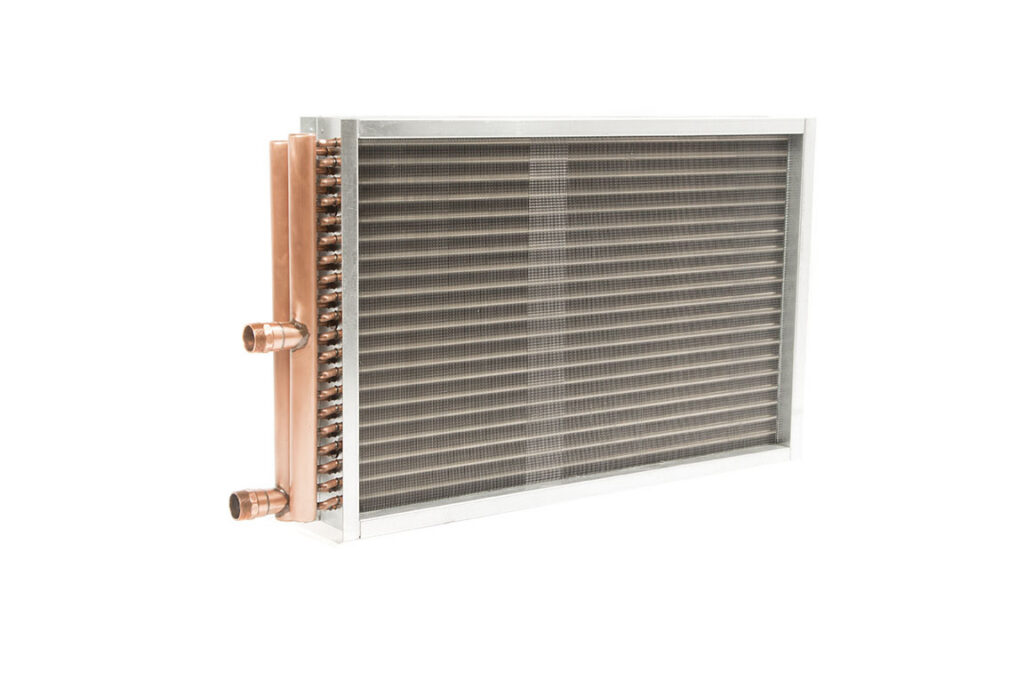
Steam coils are steam-to-air heat exchangers. That means steam flows through tubes while a fan moves air across fins. Steam coils support heat transfer into the airstream, and condensate returns to the boiler.
Steam coils are commonly seen in air-handling units, unit heaters, industrial dryers, and data centers. Finned steam coils heat air and serve several air handlers from one boiler. Other steam heat exchangers are good for heating process liquids.
How Steam Coils Work: Heat Transfer Principles
How do steam coils work, exactly? Steam enters the header and moves through the tubes. Condensation releases latent heat to the tube wall. The heat transfer coefficient is high, with steam temperature staying nearly constant at a given pressure.
Energy moves through the tube and fins by conduction, and air crossing those surfaces warms by convection. Fins add far more area than bare tubes, raising the heat transfer rate without a significantly larger coil face.
Higher steam pressure raises saturation temperature, increasing the temperature difference driving heat transfer. Many HVAC steam coils run around 5 to 15 PSI, but steam pressure needs to match the design, valve, trap, materials, and capacity; pressure cannot correct poor drainage or airflow.
Standard and Steam-Distributing Coil Types
Standard steam coils take a continuous path from supply to return. Single-pass designs, typically one to three rows, suit non-modulating reheat and unit heaters. Multiple-pass circuiting is helpful for fitting more tube length into limited space, but drainage needs to be reviewed.
A steam distributing coil uses tube-within-tube construction to deliver even distribution and freeze resistance. Common pairs are a 5/8-inch outer tube with a 3/8-inch distributor or a 1- to 1-1/8-inch outer tube with a 5/8-inch distributor. Single-pass connections sit at opposite ends.
Select standard steam coils for on-off applications with entering air above freezing. Choose steam-distributing coils below 40°F or with a modulating valve.
Steam Coil Components, Materials, and Manufacturing
Core components include headers, tubes, return bends, fins, casing, connections, and supports. Headers sized for steam and condensate loads feed each circuit evenly. Poor distribution creates hot spots; trapped condensate reduces the usable surface.
In steam coils, copper tubes conduct well at low-to-moderate pressures. Stainless steel suits higher pressures or corrosion, but it conducts less heat. Aluminum fins are more economical, but copper fins conduct better. Stainless casings, coatings, and wider spacing are all ways to address corrosion and cleaning proactively.
Coil and Header Design for Reliable Performance
Place the inlet for even distribution and pitch tubes and piping toward drains. Coilmaster offers 5/8-inch tubes with 0.025-, 0.035-, or 0.049-inch walls and 1-inch tubes with 0.035- or 0.049-inch walls. Dimensions are dependent on pressure, temperature, corrosion, and codes.
Fin density balances heat transfer, air-pressure drop, and cleanliness. Tighter spacing adds area but collects dirt faster; however, proper circuiting limits condensate buildup. Oval tube technology reduces air resistance and fan energy while retaining useful surface contact.
HVAC Integration and the Hot Water Comparison
Steam coils receive vapor, release latent heat, and drain condensate through a trap. Hot water coils circulate liquid and transfer sensible heat as water cools. Steam offers high capacity in a compact heat exchanger, while water often provides smoother modulation and lower surface temperatures.
Steam systems use pressure-rated valves, traps, vacuum breakers, and condensate piping; hot water systems use pumps, balancing valves, and two- or three-way valves. Freeze protection demands a mix of uniform airflow, positive drainage, proper trapping, adequate steam pressure, and responsive controls.
Steam heat is still in use across many hospitals, campuses, factories, and older buildings. It is less common in new comfort heating since hot water and heat pumps simplify zoning, reduce losses, and avoid trap maintenance. Costs ultimately come down to fuel, boiler efficiency, insulation, condensate return, hours, and upkeep.
Sizing, Heat Transfer Calculations, and Performance Testing
Start with Q = 1.08 × CFM × ΔT for air, where Q is BTU/h. General heat exchanger checks use Q = U × A × LMTD. U is the overall heat transfer coefficient, A is area, and LMTD is log mean temperature difference.
Selections should report entering and leaving air temperatures, airflow, BTU/h, air-pressure drop, steam pressure, and condensate load. Estimate the air-side and steam-side effects. Validate steam coils under measured airflow and temperatures with an AHRI 410-aligned rating method or factory test.
Installation, Commissioning, Maintenance, and Troubleshooting
Install steam coils with the specified pitch, connect the inlet, size the trap for load and differential pressure, and avoid lifts that can cause waterlogging. During commissioning, warm the system gradually, confirm trap discharge, check the valves and strainers, measure temperatures, and listen for water hammer.
Inspect steam coils and clean fins on a consistent schedule. Examine all tubes, headers, connections, supports, traps, and corrosion-prone surfaces. Although a hot water coil can last 15 to 25 years, chemistry, cleaning, pressure, freeze events, and environment shape its lifespan.
If steam coils heat unevenly, verify the airflow, valve travel, distribution, supply, and drainage. For banging, look for pooled condensate, failed traps, poor pitch, or rapid valve action. Replace leaking coils rather than patching them repeatedly.
The Coilmaster Advantage: Custom Steam Coil Solutions
Coilmaster crafts custom steam coils for OEM production and aftermarket replacement, including corrosion-resistant materials, special casings, and application-specific circuiting. Our manufacturing network offers nationwide support, fast lead times, and expedited custom production when capacity allows.
EZCoil and VirtuaLab compare heat transfer performance, pricing, drawings, circuiting, and airflow profiles before production begins. Coilmaster tests in a 20-ton psychrometric chamber, offering oval tubes for lower air-pressure drop. This replaces obsolete steam coils without forcing a fit.
Resources and Next Steps
Check Coilmaster’s steam coil guide specifications for tube, fin, header, casing, testing, and operating details, or explore our selection software for modeled performance. Our resources are designed to turn a load calculation into buildable steam coil components.
Before requesting steam coils, document the face dimensions, materials, rows, fin spacing, entering air conditions, airflow, leaving temperature, available steam pressure, and connections. For replacement requests, add photos, nameplate data, connection locations, and any history of freezing, corrosion, noise, or uneven heat transfer.
Request a quote or technical consultation from Coilmaster today. Our engineers can review duty, footprint, materials, controls, lead time, and aftermarket fit, then recommend a standard or steam-distributing heat exchanger for your application.