

Heat exchangers form the core of modern cooling and heating systems. From data centers to supermarkets and plants, choosing the right exchanger is critical for energy use, reliability, and total cost of ownership.
In this guide, we explore the breadth of heat exchanger options, why selection is so important, and how Coilmaster supports HVAC OEMs, data center OEMs, supermarkets, and aftermarket buyers with robust engineering, testing, and service.
What is a Heat Exchanger?
Heat exchangers are designed to transfer thermal energy between two or more fluids without mixing them. The core concept is straightforward: keep the streams separate but let heat move from the hotter to the cooler one. Indirect contact heat exchangers route heat through walls, while direct contact exchangers allow fluids to meet directly.
Heat transfer performance, pressure drop, and maintenance needs all hinge on the construction and flow configuration, so a well-chosen exchanger improves efficiency and reliability over the life of a system. Coilmaster delivers standard and customized cooling solutions for diverse needs.
Heat Exchanger Types by Construction
Construction-based classification helps engineers choose options that are closely aligned with operating conditions and service life. Compact constructions favor weight, space, and heat transfer in confined HVAC settings, while robust constructions prioritize durability in high-pressure or dirty environments.
Coilmaster’s product categories for OEMs offer a wide range, from compact plate heat exchangers to heavy-duty shell-and-tube configurations with scalable options for aftermarket applications.
Shell-and-Tube Heat Exchangers
Shell-and-tube setups have a cylindrical shell that contains multiple tubes. Hot fluid flows through the tubes while cooler fluid passes them within the shell, allowing for robust heat transfer. This arrangement is a workhorse across heavy industrial settings thanks to its ability to tolerate high pressures and temperatures. Finned-tube options are often paired with shell-and-tube cores to enhance air-side heat transfer when the exchanger interfaces with air streams. Maintenance and cleaning are simple, as long as there’s access to the shell and tube bundles for periodic inspection and tube cleaning.
Plate Heat Exchangers
Plate heat exchangers count on a stack of thin plates creating small channels. This yields a large surface area in a compact footprint, delivering high heat transfer coefficients. Plate exchangers are popular for HVAC and refrigeration, regarded for their compactness, efficiency, and ease of cleaning. When thermal response is required, plate heat exchangers frequently outperform shell-and-tube. Coilmaster provides an expansive plate exchanger catalog for OEMs, including gasketed and brazed variants to meet diverse service demands.
Frame Heat Exchangers
Frame heat exchangers combine gasketed plates in a frame for serviceability and modularity. The frame design enables easy disassembly for cleaning and gasket replacement, which is a valuable advantage in systems with frequent fouling or hygiene requirements. Gasketed plates are contrasted to brazed plates, which offer a sealed, compact alternative with higher pressure capabilities. In settings where service access and reliability are non-negotiable, plate & frame configurations strike a balance between performance and maintainability.
Brazed Plate Heat Exchanger
Brazed plate exchangers feature plates brazed together, forming a sealed unit with a compact footprint and exceptional pressure tolerance. Sealed construction makes brazed plates suitable for refrigeration cycles and closed-loop applications where leak risk must be mitigated. Their compactness and durability make them a common choice for OEMs seeking space-efficient, high-efficiency solutions in small equipment rooms or enclosures.
Finned-Tube Heat Exchanger
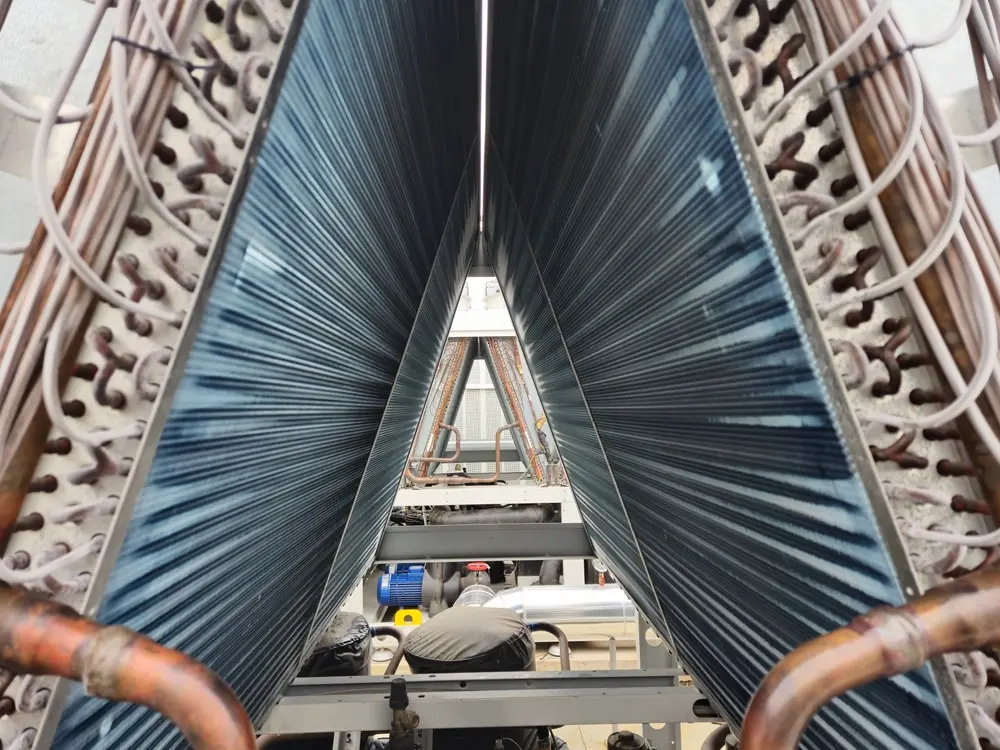
Finned-tube exchangers extend the surface area with fins on the tubes, boosting air-side heat transfer. They are commonly seen across HVAC coil applications, where air is moved across tubes by fans. The fins increase the effective heat transfer area, boosting efficiency for space-constrained units. Finned-tube designs are ideal when air-to-fluid duty is a central consideration.
Air Cooled Heat Exchangers
Air cooled heat exchangers use ambient air from fans or natural convection to take heat away from process fluids inside tubes. These are favored where water use is limited or costly, or in climates that provide sufficient air movement. Fluid cooler and condenser variants are common offshoots in data centers, power plants, and process industries, enabling integration with existing layouts.
Double-Pipe and Tube-in-Tube Heat Exchangers
Double-pipe heat exchangers have two concentric tubes, with one fluid inside the inner pipe and the other in the annulus. This simple yet strong design is economical for small-scale duties and high-pressure services where a compact solution is preferred. They’re known for easy maintenance and predictable performance, often seen in pilot installations, laboratories, or OEM configurations.
Spirals, Plate-and-Shell, and Pillow Plate Types
Spiral heat exchangers provide a self-cleaning flow path with good fouling resistance. In a hybrid design, plate-and-shell arrangements pair plate heat transfer efficiency with shell-side protection. Pillow plates, or dimple plates, are seen in tank jackets and some sanitary processes. These designs are particularly trusted for fouling-prone or sanitary applications, where cleaning protocols and material compatibility drive decision-making.
Scraped-Surface Heat Exchangers
Scraped-surface exchangers feature a blade that continuously scrapes the interior to prevent fouling from viscous or particulate-laden fluids. These are ideal for food, pharmaceutical, and high-viscosity processes where regular fouling would otherwise degrade performance. Cleaning and mechanical maintenance are part of standard operation, so choosing the right blade design shapes long-term efficiency and reliability.
Direct Contact and Indirect Contact Heat Exchangers
Direct contact exchangers combine fluids to transfer heat directly, often in spray or splash setups. Indirect contact exchangers separate fluids, transferring heat through a barrier wall. Each approach comes with its own pros and cons: direct contact can enable rapid heat transfer with a simple design, but it also entails cross-contamination risk; indirect contact might offer containment and material compatibility, but it can incur higher pressure drop or fouling potential. The right approach comes down to process hygiene, contamination risk, and required thermal performance.
Flow Arrangement and Thermal Performance
Flow arrangement shapes the heat transfer efficiency, as well as the sizing of a unit. It affects LMTD—the logarithmic mean temperature difference—which, in turn, drives thermal performance and required heat transfer area.
Counterflow delivers strong, consistent temperature driving force, while parallel flow limits the temperature differential early on. Crossflow arrangements are common when one fluid is a gas or when the second fluid’s properties vary. Hybrid designs, meanwhile, blend features to meet space or pressure constraints. In practice, engineers map arrangements to the process temperature profile, pressure drop targets, and footprint limitations.
Counterflow Heat Exchangers
Counterflow configurations maximize the temperature difference across the exchanger to promote high thermal efficiency. This setup is typically recommended where tight approach temperatures are needed, like data center cooling loops, high-efficiency HVAC systems, or industrial process streams with large temperature disparities. A simple temperature profile sketch can help stakeholders visualize the advantage: hot inlet temperatures on one side and colder inlet on the opposite side, with heat moving from hot to cold along the entire length.
Parallel Flow Heat Exchanger
In parallel flow, both fluids enter from the same end, then move in the same direction. While this arrangement has simpler design and maintenance, it also has lower overall efficiency since the temperature difference narrows quickly. Nonetheless, it is still suitable for applications where outlet temperatures should be similar or where space constraints favor a small design.
Crossflow and Hybrid Flow Configurations
Crossflow shapes are common when one fluid passes perpendicular to the other, especially with air streams or liquid cooling loops. Hybrid flow designs combine crossflow and counterflow to balance space, performance, and pressure considerations. For OEM and aftermarket projects, these configurations provide the flexibility needed for unusual operating envelopes, such as data centers with evolving IT loads or supermarkets with fluctuating case temperatures.
Classification By Cooling Medium and Contact Mode
Air, water, and refrigerant-based cooling are the core families. It also helps to clarify indirect versus direct contact, since the medium and contact mode determine hygiene, contamination risk, and required seal technology.
Air vs Water vs Refrigerant-Based Systems
Air cooling excels in environments where water supply is limited or where ambient air is plentiful. Water cooling offers high heat transfer coefficients, common in process industries and data centers with large heat loads. Refrigerant-based exchangers leverage phase change and compact designs for high efficiency in small spaces. Your choice should ultimately reflect operating costs, climate, maintenance, and compatibility with existing systems.
Heat Recovery, Regenerative, and Waste Heat Solutions
Heat recovery seeks to reclaim energy from hot streams to precondition incoming ones. Regenerative and recuperative options each have distinct heat exchange paths and component requirements.
Applications in Power Generation
Power plants count on condensers and air-cooled condensers to manage turbine exhaust and steam systems. Condensers often use shell-and-tube or plate configurations for robust heat rejection to cooling water or air. Air-cooled condensers, in particular, reduce water use and enable site flexibility. Steam condensation and turbine cooling cycles showcase how heat exchangers drive overall thermal efficiency and uptime.
Selection Criteria and Design Considerations
Disciplined design covers several criteria:
- Pressure drop: Impacts pumping power and energy use; higher pressure drop lowers efficiency.
- Fouling potential: Determines heat transfer effectiveness and required maintenance; choose cleanable designs in fouling-prone services.
- Material compatibility and corrosion resistance: Select alloys that can endure the process chemistry and operating temperatures.
- Maintenance, cleanability, and accessibility: Needed for reliable service and long life.
- Allowable approach temperature and sizing tradeoffs: Balance space with required thermal performance.
- Codes and standards: Reference all relevant codes to align with customer expectations and regulatory requirements.
Performance Enhancements and Features
Next-level performance is made possible by design details such as enhanced surfaces and fins, multi-pass configurations, and baffling arrangements. Oval tube technology offers improved heat transfer, lower pressure drop, or both, depending on the geometry and flow. When appropriate, discuss multi-pass designs to spread thermal duty and control fouling.
Our Solutions and Differentiators
We’re known for our custom-coil capabilities, oval tube technology, and a strong emphasis on testing and verification. Our EZCoil® selection tool helps engineers rapidly prototype coils to match load profiles, while VirtuaLab® testing tools allow virtual and physical validation of performance.
Nationwide engineering support underpins OEM and aftermarket service, making Coilmaster a practical partner for HVAC, data center, supermarket, and industrial projects.
Common Use Cases
- HVAC systems: A modern office building uses plate heat exchangers for refrigerant-to-water cooling loops, with finned-tube elements in AHU coils to boost air-side heat transfer.
- Data center cooling: Efficient counterflow and hybrid flow arrangements facilitate high-density IT loads while maintaining low approach temperatures.
- Supermarket/refrigeration: Brazed plate exchangers provide compact, reliable cooling for display cases and walk-in coolers, coupled with robust cleaning protocols.
- Industrial process or power generation: Shell-and-tube and crossflow configurations support high-pressure streams in refinery and chemical processing settings, improving plant uptime and energy efficiency.
Maintenance, Troubleshooting, and Retrofit Guidance
Be sure to follow these best practices:
- Routine fouling inspections prevent deltas in performance and pinpoint maintenance windows.
- Cleaning methods per exchanger type include plate cleaning with appropriate chemical cleaners, shell-and-tube bundle removal and tube cleaning, or finned-tube coil washing with compatible detergents.
- Choose between replacement or repair based on corrosion, leak risk, and the remaining service life of the components.
- Regular lubrication and seal checks are essential in gasketed plate or brazed plate systems, and surfaces should be kept dry to prevent corrosion in high- humidity environments.
- Retrofit requires compatibility with existing interfaces, pressure ratings, and the potential need for new pumps or control strategies to preserve system efficiency.