
Smart coil selection starts with a strong understanding of how heat moves. If you’re an OEM, engineer, or facility manager, knowing the types of heat transfer makes it easier for you to compare materials, set airflow requirements, and track down performance problems.
What is Heat Transfer?
Heat transfer is thermal energy that moves due to a temperature difference. Energy naturally flows from warmer areas to cooler ones, but how fast it moves hinges on the materials and dimensions. Conduction, convection, and radiation are the ways in which heat transfer occurs.
Thermal Conductivity and Material Selection
Thermal conductivity measures how easily heat passes through material. Copper and aluminum conduct well since the free electrons carry energy. Poor conductors, on the other hand, make for useful insulators.
For tubes and fins, compare the conductivity against the corrosion resistance, fluid compatibility, pressure, temperature, fabrication, and cost. For insulation, check thermal resistance at the intended thickness and temperature, accounting for moisture exposure and installation conditions.
Surface finish can also affect radiation; dark, matte surfaces usually absorb more sunlight than reflective ones do. But rather than judging infrared emissivity by color alone, be sure to confirm the coating’s measured properties.
Thermal Conduction: How Heat Moves Through Solids
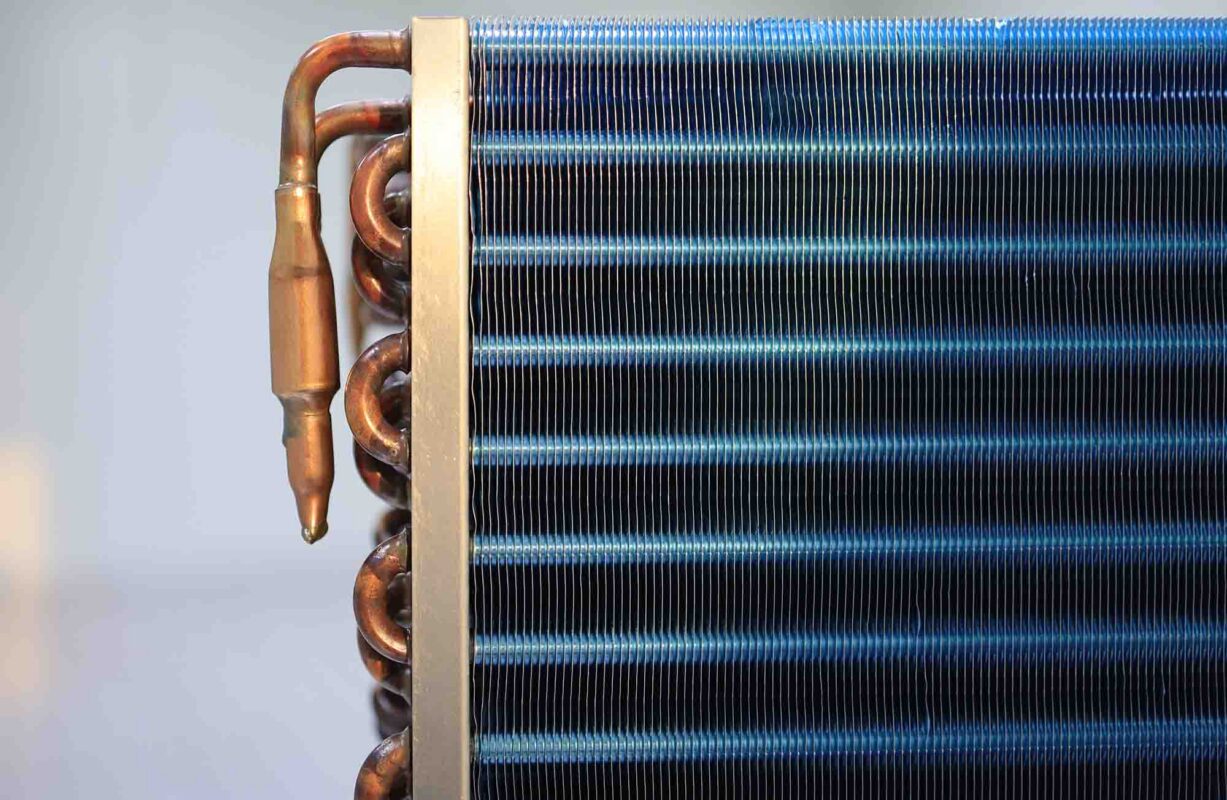
Conduction moves heat through materials and across surfaces. In fluid coils, it carries energy through metal walls and attached fins. It’s the main way that heat moves within those stationary parts, but metal choice and wall thickness both influence how well a coil will perform.
Ten typical examples include heat passing through coil tubes, coil fins, boiler tubes, heat exchanger plates, and electronic heat sinks. You’ll also find it in cooking pans, soldering tips, clothes-iron plates, hot handles, or ice melting in your palm.
If heating or cooling is not ongoing, connected objects approach thermal equilibrium and net heat flow stops. When you’re troubleshooting coils, check the tube-to-fin contact, corrosion, and scale. Gaps and deposits add resistance that slows down the heat flow.
Thermal Convection: How Heat Moves in Fluids
Convection involves liquids or gases that are moving. Natural convection does not need any mechanical help; temperature-related density differences cause movement, like warm air rising above a radiator.
Forced convection counts on fans or pumps. Fans push the air across the coils, and the pumps move water or glycol through the tubes. These moving fluids then transfer heat as they pass by warmer or cooler surfaces.
When specifying coils, include the airflow volume, face velocity, allowable air-side pressure drop, and entering air temperature and humidity. Uneven airflow can leave part of a coil underutilized. Higher flow can help improve heat transfer, but it can also increase fan or pump energy use.
Thermal Radiation and Heat Energy Transfer Across Space
Radiation travels as electromagnetic waves, so it doesn’t need a material medium. It’s how sunlight crosses space, for instance. Every object that’s above absolute zero emits thermal radiation.
Rooftop equipment and outdoor cabinets absorb sunlight and exchange radiation with the surrounding surfaces. Emissivity measures how effectively a surface emits radiation compared to an ideal emitter at the same temperature.
Look into solar-reflective finishes for exposed cabinets and roofs, along with suitable thermal emittance. Reflective shields reduce exposure, but don’t block airflow or service access. Keep unapproved coatings off coil fins, as they can impact thermal performance.
Heat Exchangers, Heat Transfer Coefficient, and Coil Design
Heat exchangers move energy between fluids. Typical HVAC designs include finned-tube coils, plate exchangers, and shell-and-tube units.
The convective heat transfer coefficient, h, refers to heat flow between a surface and fluid per unit area and temperature difference; higher values indicate more transfer under the same conditions. The overall coefficient, U, accounts for the combined resistances.
Always ask for air-side and fluid-side h-values, operating conditions, rated capacity, and the surface area used in calculations. Check whether that area includes the fins or only the bare tube surfaces, because otherwise you won’t know whether you’re comparing results on the same basis.
Counterflow works well when one fluid leaves near the other fluid’s entering temperature. Crossflow is good for air passing across coil tubes; multirow coils can also use counterflow circuiting. Compare the pressure drops and part-load performance, too.
Conduction, Convection, and Radiation: Combined Effects in HVAC Systems
Outdoor condensers use all three. Heat crosses tubes and fins by conduction, moves into airflow by convection, then exchanges with surrounding surfaces through radiation.
Fix the biggest restriction first, whether that’s clearing blocked airflow, cleaning fouled surfaces, or limiting solar exposure. Additionally, insulate any piping where unwanted heat exchange wastes energy. Thermal resistance measures the opposition to heat flow; insulation maintains process temperatures while lowering heating or cooling demand.
Transfer Of Heat: Practical Calculations and Tips
For steady, one-dimensional conduction through a flat wall with constant conductivity, you can use Fourier’s law: Q̇ = kA(T₁ − T₂)/L. Q̇ is the heat transfer rate, k is the conductivity, A is the area, and L is the thickness. T₁ and T₂ are the wall-face temperatures.
For convection, you can use Newton’s law: Q̇ = hA(Ts − Tf). Ts is the surface temperature, and Tf is bulk fluid temperature. Here, h is the convective heat transfer coefficient.
If temperatures shift over time, calculate Bi = hLc/k, where Lc is volume divided by exposed surface area. A Biot number below 0.1 allows a lumped-capacitance approximation, treating the solid’s internal temperature as uniform.
Use our VirtuaLab® simulations to assess circuiting and airflow distribution, then validate your predictions against the rating or test data.
Coilmaster Solutions: Custom Coils, Condensers, and Energy Recovery
Coilmaster crafts custom coils and remote air-cooled condensers for OEM and replacement applications. Shop our full selection of energy recovery systems, or use EZCoil® for performance data and drawings.
See all Coilmaster solutions and request a quote today, detailing your operating conditions and installation requirements.