

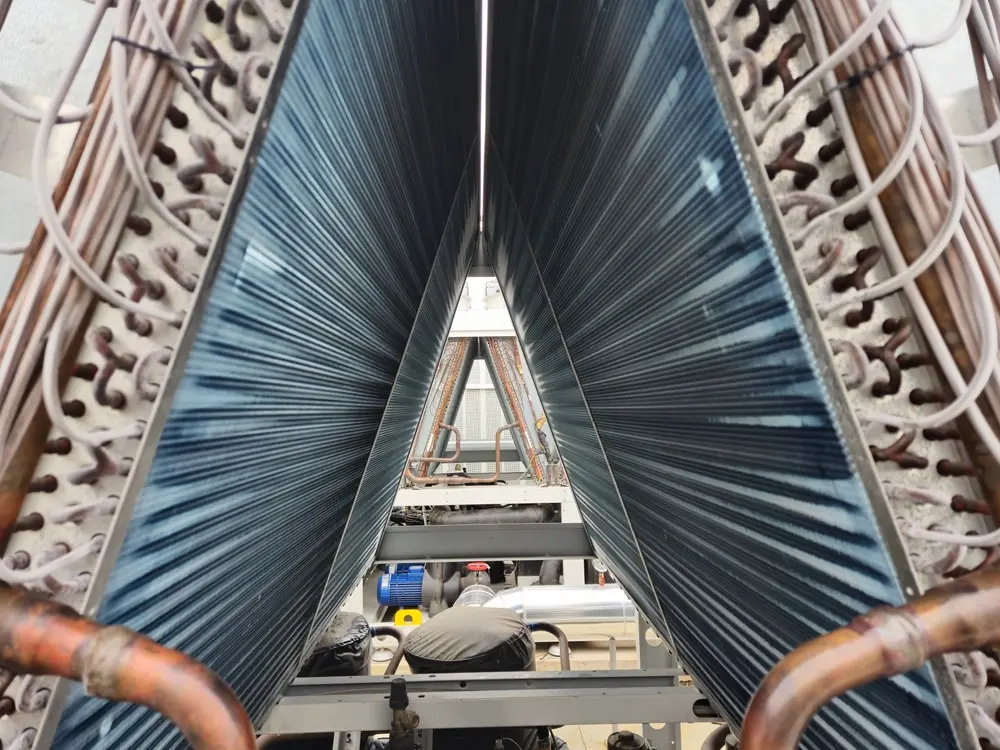
The main difference between a cased vs. uncased coil is how it is supplied for installation. A cased coil comes inside a factory-built cabinet, while an uncased coil is supplied without an enclosure so it can be integrated into an existing or custom cabinet or plenum.
Neither option is automatically better. Choosing between cased vs. uncased coils depends on available space, equipment configuration, airflow requirements, and whether the project involves new equipment or an existing system.
What Is the Difference Between a Cased and Uncased Coil?
Cased evaporator coils arrive inside a manufactured cabinet designed to house and protect the coil. Depending on the design, the enclosure may include insulation and condensate-management components. Its defined dimensions and airflow path can also simplify integration when the coil and surrounding equipment are properly matched.
An uncased coil provides the heat exchanger without the outer cabinet. Uncased evaporator coils can be mounted inside an existing air handler, cabinet, or field-fabricated plenum, giving contractors and equipment manufacturers more flexibility.
That flexibility requires additional attention during installation. The enclosure must be properly sized, mounted, sealed, and configured for airflow and condensate drainage.
When Should You Use a Cased Coil?
A cased coil is often a practical choice for new installations and equipment replacements when its cabinet dimensions align with the rest of the system. Since the enclosure is already manufactured around the evaporator coil, less field fabrication may be necessary.
The cabinet also protects during shipping, handling, and installation. For applications with compatible equipment dimensions, this can create a more straightforward path from coil selection to final installation.
Still, the case itself does not determine performance. Capacity, airflow, refrigerant compatibility, circuiting, and proper installation remain important.
When Is an Uncased Coil a Better Fit?
An uncased coil can make more sense when replacing a coil inside an enclosure that is still in usable condition. It can also accommodate custom equipment or installations where a standard factory cabinet does not fit the available space.
This flexibility makes uncased designs useful for retrofit work, but field installation becomes especially important. Contractors need to account for coil positioning, airflow, sealing, drainage, and connections to existing refrigerant lines.
When comparing cased vs. uncased, the condition and dimensions of the surrounding equipment should therefore be considered alongside the coil itself.
What Should You Consider When Choosing Cased vs. Uncased Coils?
Start with the application’s actual requirements. Coil capacity, dimensions, airflow, allowable pressure drop, refrigerant, condensate management, and available installation space can all influence the decision.
A properly selected evaporator coil should fit the equipment and provide the required thermal performance regardless of whether it arrives with a factory case. For replacement applications, accurate measurements and operating specifications are particularly important before ordering a new coil.
Find the Right Coil for Your Application
Choosing between cased and uncased coils comes down to the equipment, available space, and installation requirements. A cased coil can simplify installation when a compatible cabinet fits the system, while an uncased coil provides more flexibility for retrofits, custom equipment, and existing enclosures.
If you need help selecting a new or replacement coil, Coilmaster can review your specifications, dimensions, and operating requirements to help determine the right configuration. Contact us to discuss your application with our team.