

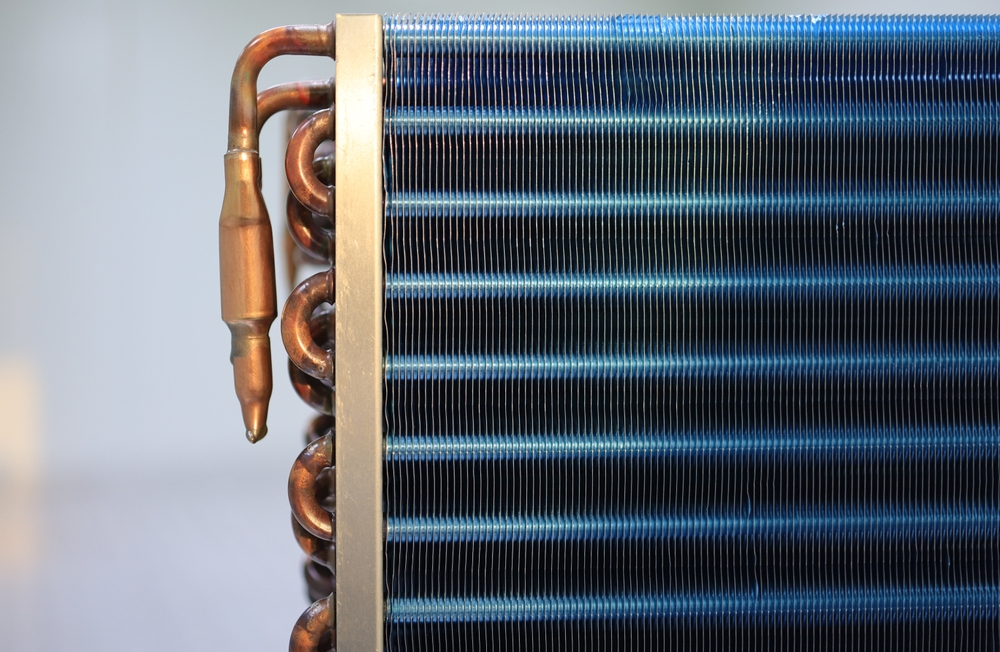
Improving heat transfer in a heat exchanger starts with a few fundamentals: providing enough surface area, maintaining the right temperature difference, optimizing airflow and fluid flow, and keeping coils clean. Coil design and materials also affect how effectively thermal energy moves through a system.
More heat transfer is not always the only goal. Changes that increase capacity can also create greater resistance to airflow or fluid flow and require more energy from fans or pumps. Finding the right balance is important in HVAC/R, refrigeration, industrial cooling, and data center equipment.
What Factors Affect Heat Transfer in a Heat Exchanger?
Temperature difference is one of the primary drivers of heat transfer. Generally, the greater the difference between the hot and cold sides, the greater the potential for thermal energy to move between them. Surface area matters as well. Fins expand the area available to exchange heat with passing air, while tube arrangement and coil depth influence how effectively that area is used.
Other factors include the thermal conductivity of tube and fin materials, airflow, fluid velocity, circuiting, and the convective heat transfer coefficient. Dirt and other buildup can reduce performance by insulating surfaces or restricting air movement. These variables interact, so improving heat transfer usually requires looking at the heat exchanger as a complete system rather than changing one parameter.
How Can Coil Design Improve Heat Transfer?
Coil geometry creates several opportunities for heat transfer enhancement. Engineers can adjust fin spacing, fin design, tube size and arrangement, number of rows, and circuiting to suit a particular application.
Increasing effective surface area provides more area for energy to pass between the fluid and airstream. There are practical limits, however. Adding rows or tightening fin spacing may create additional resistance as air moves through the coil.
Tube geometry also affects how air travels across heat transfer surfaces. Material selection is another consideration. Tube and fin materials need suitable thermal properties while meeting requirements for corrosion resistance, temperature, durability, and the environment where the equipment will operate.
How Do Airflow and Fluid Velocity Affect Heat Transfer?
Airflow and fluid velocity directly affect convective heat transfer. Increasing velocity can create greater turbulence, which disrupts the thermal boundary layer near a heat transfer surface and may allow energy to move more effectively.
Simply increasing velocity is not always the answer. Moving more air through a restrictive coil can demand additional fan power, while higher fluid velocity can increase pumping requirements.
Circuiting helps manage this trade-off on the fluid side. The goal is to distribute fluid at velocities that provide the necessary capacity without introducing excessive resistance. This is especially important in high-capacity HVAC/R, refrigeration, and data center cooling equipment that may operate for long periods.
How Can You Improve Heat Transfer in an Existing HVAC System?
Knowing how to improve heat transfer is useful for existing equipment as well as new designs. Maintenance is often the first place to look when performance begins to decline. Dust, dirt, grease, and other contaminants can build up on coils, limiting heat exchange and restricting airflow through the fins. Cleaning the coil using procedures appropriate for its construction and coatings can help maintain performance.
Physical condition matters too. Bent fins may interfere with airflow, while corrosion, leaks, and other damage can affect reliability. The surrounding equipment should also be checked. Filters, fans, pumps, dampers, valves, and controls can affect how much air or fluid reaches the coil.
When a coil is heavily corroded, leaking, or no longer able to meet capacity requirements, replacement may be more practical than continued maintenance.
How Can OEMs Specify Coils for Better Heat Transfer?
Good heat exchanger selection begins with accurate information about the application. Capacity is important, but engineers also need to understand the conditions under which that capacity must be delivered.
Important specifications include:
- Required heating or cooling capacity
- Entering and leaving air temperatures
- Fluid type and temperatures
- Airflow and fluid flow rates
- Allowable air- and fluid-side pressure drops
- Available dimensions and installation space
- Tube and fin material requirements
- Environmental and corrosion conditions
These details allow engineers to match tube geometry, fin configuration, coil depth, circuiting, and materials to the equipment. Requirements also vary by market. An air handling unit, refrigerated display case, and data center cooling system may each require a different combination of capacity, footprint, airflow, and fluid characteristics. Providing complete specifications early helps avoid selecting a coil based on capacity alone.
Why Does Pressure Drop Matter When Improving Heat Transfer?
Many methods for improving heat transfer come with a trade-off. Additional surface area, greater turbulence, and higher velocities may increase heat exchange while also making it harder to move air or fluid through the coil.
Greater air-side resistance can increase fan power requirements. On the fluid side, pumps may need to work harder to maintain the desired flow.
The highest possible heat transfer coefficient is therefore not necessarily the best design target. A heat exchanger needs to provide the required capacity without placing unnecessary demands on the rest of the equipment. Energy consumption, airflow, pumping requirements, available space, and thermal performance all factor into that balance.
How Does Better Heat Transfer Support Data Center Cooling?
Growing computing densities are increasing the amount of heat that data center cooling equipment must manage. At the same time, equipment often needs to fit within limited footprints while meeting demanding efficiency requirements.
Liquid cooling adds another consideration. Coolant Distribution Units, or CDUs, manage coolant circulation between cooling loops, while heat exchangers move thermal energy through the cooling system. Proper heat exchanger sizing and controlled coolant flow can help support reliable temperature management as rack densities increase.
Improve Heat Transfer with the Right Heat Exchanger
There is no single adjustment that guarantees better heat transfer in every application. New equipment benefits from heat exchangers designed around its actual capacity, airflow, fluid, and space requirements. Existing systems may need cleaning, airflow corrections, maintenance, or a replacement coil to restore performance.
With more than 25 years of experience serving OEM and aftermarket HVAC/R customers, Coilmaster provides custom heat transfer solutions for demanding applications. Need a new or replacement coil? Send us your specs or drawings and contact our engineering team about what your application requires.